Introductory Circuit Analysis 13th Edition PDF: A Comprehensive Plan
Boylestad’s 13th edition, alongside supplementary materials like Krause’s machinery analysis manual, offers robust learning. Rio de Janeiro quizzes and PCB topology insights complement electrical studies.
I. Overview of the 13th Edition
The 13th edition of “Introductory Circuit Analysis” by Robert L. Boylestad represents a significant update to a long-standing, highly respected textbook in electrical engineering education. This edition continues the tradition of providing a comprehensive and accessible introduction to fundamental circuit concepts. It builds upon previous editions, incorporating modern examples and updated content to reflect current industry practices;
Supplemented by resources like solutions manuals and study guides – even materials extending to areas like organic chemistry study aids and machinery analysis – the 13th edition aims for a holistic learning experience. Interestingly, seemingly unrelated topics like Rio de Janeiro trivia quizzes appear alongside circuit analysis discussions online, highlighting the diverse learning landscape. The text emphasizes practical application, preparing students for real-world challenges in circuit design and troubleshooting, alongside considerations for PCB topology and delay device circuits.
Pearson’s global edition (9.78129E12, 2015) and related resources, including Krause’s manual, offer students a pathway to mastering circuit analysis principles effectively.
Key Features and Updates
The 13th edition of Introductory Circuit Analysis builds upon its established reputation, offering a thoroughly revised and updated learning experience. While specific details regarding changes aren’t explicitly stated in the provided snippets, the mention of supplementary materials – like solutions manuals for electric machinery (Krause) and study guides – suggests an enhanced focus on problem-solving and practical application.
The availability of a solutions manual is a key feature, aiding student comprehension and independent learning. Furthermore, the context of Rio de Janeiro quizzes and PCB topology discussions, though seemingly unrelated, hints at a broader integration of real-world examples and modern technological considerations within the textbook’s framework.
Updates likely include revised examples, new practice problems, and potentially, coverage of emerging technologies in circuit design and analysis. The emphasis on delay devices using ring oscillators, as mentioned, could indicate an expansion into more advanced topics. The textbook aims to provide a comprehensive and current understanding of fundamental circuit principles.
Target Audience and Prerequisites
Introductory Circuit Analysis, 13th edition, is primarily targeted towards undergraduate students enrolled in introductory electrical engineering or related technology programs. The textbook assumes a foundational understanding of basic algebra and trigonometry, essential for manipulating circuit equations and analyzing waveforms. Prior knowledge of physics, particularly concepts related to electricity and magnetism, is also highly beneficial.
While not explicitly stated, the inclusion of advanced topics like ring oscillator-based delay devices suggests the material can also benefit students seeking a more in-depth understanding beyond the introductory level. The supplementary materials, such as Krause’s machinery analysis manual, indicate a potential bridge to more specialized electrical engineering coursework.
The textbook’s accessibility is enhanced by available study guides and solutions manuals, making it suitable for self-study and independent learners. No prior circuit analysis experience is required, as the book systematically builds concepts from the ground up.
Availability and Formats (PDF, Print, Online)
Introductory Circuit Analysis, 13th edition, is widely available through various channels. A physical print copy can be purchased from major booksellers, including Pearson directly, and online retailers like Amazon. A PDF version is often accessible through Pearson’s online learning platforms, requiring purchase or subscription access. Digital formats are increasingly popular, offering convenience and portability for students.
The “Global Edition” (ISBN 978129E12) indicates international availability, potentially with differing pricing and packaging. Supplementary materials, like solutions manuals, are often sold separately in both print and digital formats. Access to online resources and tutorials may require the purchase of accompanying courseware or a bundled package.
Considering the mention of quizzes and online learning, Pearson likely offers interactive digital versions alongside the traditional PDF and print options, enhancing the learning experience.

II. Core Concepts Covered in the Textbook
Fundamentals include resistors, capacitors, inductors, Ohm’s and Kirchhoff’s Laws, alongside series and parallel circuit analysis—essential for electrical engineering and PCB design.
Basic Circuit Elements (Resistors, Capacitors, Inductors)
The foundational building blocks of any electrical circuit – resistors, capacitors, and inductors – receive detailed coverage within the 13th edition. Resistors, controlling current flow, are explored with various types and power ratings. Capacitors, storing energy in electric fields, are analyzed for their charging and discharging characteristics, crucial for timing circuits and filtering.
Inductors, storing energy in magnetic fields, are examined for their impedance and behavior in AC circuits. The interplay between these elements is vital, particularly when considering PCB topology for minimizing impedance. Understanding their individual properties and combined effects is paramount.
The text likely delves into practical applications, potentially referencing solutions found in manuals like Krause’s, and connects these components to real-world scenarios, even drawing parallels to complex systems like those found in Rio de Janeiro’s infrastructure. A solid grasp of these elements is essential for subsequent circuit analysis techniques.
Ohm’s Law and Kirchhoff’s Laws
Central to circuit analysis, Ohm’s Law (V=IR) and Kirchhoff’s Laws form the bedrock of understanding current and voltage relationships. The 13th edition meticulously explains Ohm’s Law, detailing voltage, current, and resistance, and their interdependencies. Kirchhoff’s Current Law (KCL), stating current conservation at a node, and Kirchhoff’s Voltage Law (KVL), outlining voltage drops around a loop, are presented with clarity.
These laws are not merely theoretical; their application is demonstrated through numerous examples, potentially mirroring problem-solving approaches found in supplementary materials. Understanding these principles is crucial for tackling more complex analyses like nodal and mesh analysis. The text likely emphasizes their importance in practical circuit design, relating to PCB impedance considerations.
Even seemingly unrelated topics, like Rio de Janeiro trivia, require logical deduction – a skill honed by mastering these fundamental laws. A firm grasp of Ohm’s and Kirchhoff’s Laws is indispensable for success.

Series and Parallel Circuits
Building upon Ohm’s and Kirchhoff’s Laws, the 13th edition dedicates significant attention to series and parallel circuit configurations. Series circuits, characterized by a single current path, are analyzed for voltage division and total resistance calculations. Parallel circuits, offering multiple paths, are explored for current division and equivalent resistance determination.
The textbook likely provides step-by-step examples, potentially referencing solutions manuals for practice. Understanding these configurations is vital for analyzing complex networks, mirroring the logic needed for quizzes about cities like Rio de Janeiro – identifying interconnected elements. The concepts extend to PCB topology, where resistance impacts signal integrity.
The edition probably emphasizes practical applications, such as calculating power dissipation in each component. Mastery of series and parallel circuits forms a crucial foundation for advanced circuit analysis techniques.

III. Circuit Analysis Techniques
The 13th edition details nodal, mesh, superposition, Thevenin’s, and Norton’s theorems, essential for solving complex circuits, alongside PCB impedance considerations.
Nodal Analysis
Nodal analysis, a cornerstone of circuit analysis presented in the 13th edition, systematically determines node voltages within a circuit. This technique leverages Kirchhoff’s Current Law (KCL) at each node, establishing a set of linear equations. By defining a reference node (usually ground), the voltage at each remaining node is calculated relative to this reference. The method excels in circuits with voltage sources, simplifying the equation-solving process.
The textbook likely provides detailed examples illustrating how to apply nodal analysis to various circuit configurations, including those found in practical electrical engineering applications. Understanding nodal analysis is crucial for analyzing complex networks and is often paired with concepts from Krause’s machinery analysis for comprehensive system understanding. Furthermore, the principles align with PCB topology considerations, ensuring accurate voltage distribution within electronic designs, even those incorporating delay devices based on ring oscillators.
Mesh Analysis
Mesh analysis, detailed within the 13th edition, offers an alternative approach to circuit analysis, particularly effective for circuits dominated by current sources. This method relies on Kirchhoff’s Voltage Law (KVL) applied around each independent loop (mesh) in the circuit. Defining mesh currents allows for the formulation of a system of linear equations, solvable to determine these currents. Subsequently, branch currents and voltages can be derived.
The textbook likely presents numerous examples demonstrating mesh analysis application, potentially linking it to practical circuit design considerations and troubleshooting techniques. A solid grasp of mesh analysis complements nodal analysis, providing versatile problem-solving skills. Concepts extend to understanding power delivery networks within PCBs, ensuring minimal impedance, and even relate to analyzing ring oscillator-based delay circuits, as highlighted in recent research. It’s a fundamental skill alongside machinery analysis from Krause’s manual.
Superposition Theorem
The Superposition Theorem, thoroughly explained in the 13th edition, simplifies the analysis of linear circuits with multiple independent sources. It states that the response in any circuit element is the algebraic sum of the responses caused by each independent source acting alone, with all other sources deactivated (voltage sources replaced by shorts, current sources by opens). This technique breaks down complex problems into manageable steps.
The textbook likely illustrates this with detailed examples, potentially connecting it to real-world applications in electrical engineering. Understanding superposition is crucial alongside mesh and nodal analysis, forming a robust toolkit for circuit solvers. Even concepts like non-contact current measurement, requiring precise circuit solutions, benefit from this foundational understanding. It’s a key element when considering PCB topology for minimal impedance, and complements studies like Krause’s machinery analysis.
Thevenin’s Theorem
Thevenin’s Theorem, a cornerstone of circuit analysis covered extensively in the 13th edition, allows complex linear circuits to be simplified into an equivalent circuit consisting of a single voltage source (VTh) in series with a single resistor (RTh). This simplification dramatically eases analysis, particularly when a specific load resistor varies. The textbook likely provides step-by-step methods for determining VTh and RTh, potentially linking it to practical design considerations.
Mastering Thevenin’s Theorem is vital alongside superposition, nodal, and mesh analysis. It’s applicable to diverse scenarios, from basic circuit troubleshooting to more advanced applications like analyzing power delivery networks and optimizing PCB topologies for minimal impedance. Understanding this theorem is also beneficial when studying related fields like electric machinery analysis, as highlighted by Krause’s manual, and even in contexts requiring precise current measurements.
Norton’s Theorem
Norton’s Theorem, closely related to Thevenin’s, provides an alternative simplification method for linear circuits. Instead of a voltage source and series resistance, Norton’s Theorem represents a circuit with a single current source (IN) in parallel with a single resistance (RN). The 13th edition likely details the process of converting any linear circuit into its Norton equivalent, offering practical examples and problem-solving techniques.
Like Thevenin’s, Norton’s Theorem streamlines analysis, especially when dealing with varying load resistances. Proficiency in both theorems is crucial for effective circuit troubleshooting and fault finding. The concepts are applicable to areas like power delivery network design, where minimizing impedance is paramount, and even in advanced applications involving precise current measurements and galvanic isolation. Understanding these theorems complements studies in electric machinery analysis, as detailed in Krause’s manual, and builds a strong foundation for electrical engineering principles.

IV. AC Circuit Analysis
The 13th edition explores sinusoidal steady-state analysis, phasors, impedance, and AC power calculations, building upon foundational circuit principles for alternating currents.
Sinusoidal Steady-State Analysis
Delving into the realm of alternating current (AC) circuits, the 13th edition meticulously covers sinusoidal steady-state analysis. This crucial section focuses on circuits driven by sinusoidal voltage and current sources, establishing a foundation for understanding AC behavior. Students learn to represent these sources mathematically and analyze their impact on circuit components.
Key concepts include the use of phasors – complex numbers representing sinusoidal quantities – to simplify circuit analysis. This allows for the application of algebraic techniques typically used in DC circuits, but adapted for AC conditions. The edition details how to determine impedance, the AC equivalent of resistance, for resistors, capacitors, and inductors.
Furthermore, the text explores techniques for analyzing circuits containing combinations of these elements, enabling students to predict voltage and current relationships in steady-state conditions. Understanding this analysis is paramount, as it forms the basis for more advanced AC circuit concepts and real-world applications, even relating to PCB topology considerations.
Phasors and Impedance
A cornerstone of AC circuit analysis, the 13th edition dedicates significant attention to phasors and impedance. Phasors, complex numbers representing sinusoidal voltages and currents, are introduced as a powerful tool for simplifying calculations. This method transforms differential equations into algebraic equations, streamlining the analysis process considerably.
Impedance, the AC equivalent of resistance, is thoroughly explained for each circuit element. The edition details how resistors exhibit resistance, capacitors exhibit capacitive reactance, and inductors exhibit inductive reactance – all frequency-dependent. Students learn to combine these impedances in series and parallel, mirroring DC circuit resistance calculations.
The text emphasizes the importance of understanding the phase relationships between voltage and current in AC circuits, which are inherently captured within the phasor representation. Mastery of phasors and impedance is crucial for tackling more complex AC circuit problems, and even influences PCB design for optimal signal integrity.
AC Power Calculations
The 13th edition comprehensively covers AC power calculations, building upon the foundation of phasors and impedance. It details the distinction between instantaneous power, average power (real power), reactive power, and apparent power, providing clear formulas and illustrative examples for each.
Students learn to calculate real power (watts) consumed by a circuit, reactive power (VARs) stored in reactive components, and apparent power (VA) representing the total power flow. The concept of power factor – the ratio of real power to apparent power – is thoroughly explained, highlighting its importance in power system efficiency.
The text emphasizes techniques for calculating power in single-phase and three-phase circuits, including balanced and unbalanced loads. Understanding these calculations is vital for electrical engineering applications, influencing PCB topology for power delivery networks, and even relating to broader concepts like Rio de Janeiro’s energy infrastructure.

V. Resources and Supplements
Solutions manuals, study guides, and online tutorials enhance learning. Krause’s analysis manual and Rio de Janeiro quizzes offer additional practice and context.

Solutions Manual Availability
Access to a comprehensive solutions manual is crucial for mastering Introductory Circuit Analysis, 13th Edition. While specific availability details vary, students often find solutions manuals through Pearson’s official channels, or via bundled packages with textbook purchases. Independent online resources may also offer solutions, but verifying their accuracy is paramount.
Furthermore, resources like Krause’s Analysis of Electric Machinery manual demonstrate the importance of accompanying solution guides for complex engineering topics. These manuals provide step-by-step breakdowns of problems, aiding in understanding core concepts and troubleshooting techniques. The availability of solutions extends beyond the textbook itself, with supplementary materials often including practice problems and worked examples. Even seemingly unrelated resources, like Rio de Janeiro trivia quizzes, can reinforce problem-solving skills through logical deduction. Students should explore all legitimate avenues to obtain a reliable solutions manual to maximize their learning experience.
Study Guides and Practice Problems
Effective learning with the 13th edition of Introductory Circuit Analysis relies heavily on utilizing supplementary study guides and a wealth of practice problems. Pearson often provides a dedicated student solutions manual, offering detailed walkthroughs for end-of-chapter exercises. These resources are invaluable for solidifying understanding and identifying areas needing further review.
Beyond the official materials, numerous online platforms and third-party resources offer additional practice problems, quizzes (even those seemingly unrelated, like Rio de Janeiro trivia, can sharpen analytical skills!), and worked examples. Resources mirroring the approach of Krause’s machinery analysis manual – providing step-by-step solutions – are particularly beneficial. Consistent practice is key to mastering circuit analysis techniques, and a diverse range of problems, from basic to complex, will ensure comprehensive preparation. Students should actively seek out and engage with these supplementary materials to enhance their grasp of the subject matter.
Online Resources and Tutorials
The digital landscape offers a plethora of online resources to supplement the 13th edition of Introductory Circuit Analysis. Pearson’s MyLab circuit platform frequently accompanies the textbook, providing interactive simulations, automated grading, and personalized learning paths. YouTube channels dedicated to electrical engineering often feature tutorials covering core concepts from the book, offering alternative explanations and visual demonstrations.
Furthermore, websites hosting practice quizzes – even those focused on diverse topics like Rio de Janeiro geography – can hone problem-solving skills. Online forums and communities allow students to connect with peers and experts, fostering collaborative learning and providing a space to ask questions. Exploring resources related to PCB topology and machinery analysis (like Krause’s manual) can broaden understanding. These digital tools, when used strategically, significantly enhance the learning experience and provide readily accessible support beyond the textbook itself.
VI. Applications and Real-World Examples
Circuit analysis principles underpin electrical engineering, PCB design, and machinery troubleshooting, as seen in Krause’s work and even Rio de Janeiro’s power grids.
Circuit Analysis in Electrical Engineering
Introductory Circuit Analysis, particularly the 13th edition by Boylestad, forms a cornerstone of electrical engineering education. Mastering its concepts is crucial for understanding complex systems, from power distribution networks to intricate electronic devices. The textbook’s principles directly apply to analyzing and designing circuits used in various engineering disciplines.
Students learn to model, analyze, and solve for voltage, current, and power within circuits, utilizing techniques like nodal and mesh analysis, superposition, and Thevenin/Norton equivalents. These skills are fundamental for designing filters, amplifiers, and control systems. Furthermore, understanding circuit behavior is essential for troubleshooting and fault finding, as highlighted by resources like Krause’s analysis of electric machinery. Even seemingly unrelated areas, like optimizing PCB topologies for minimal impedance – crucial for power delivery – rely on these core circuit analysis principles. The ability to apply these concepts extends beyond theoretical understanding, enabling engineers to create practical and efficient solutions.
Practical Circuit Design Considerations
Beyond theoretical calculations from Boylestad’s 13th edition, practical circuit design demands attention to real-world constraints. Component tolerances, parasitic effects, and manufacturing variations significantly impact performance. Engineers must consider these factors when selecting components and designing circuits for reliability and stability.
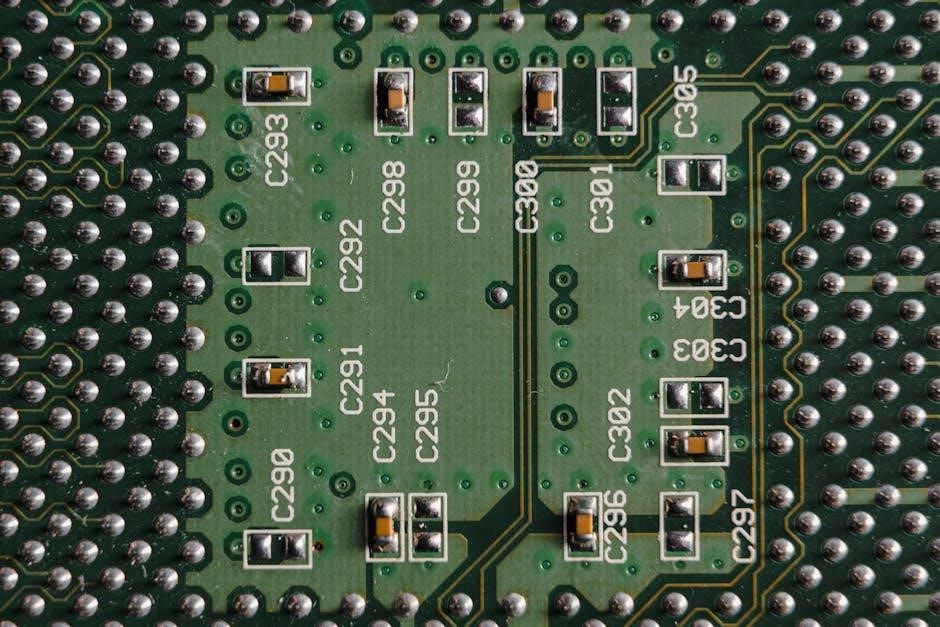
Effective PCB topology, minimizing impedance in power delivery networks, is paramount, as discussed in related resources. Selecting appropriate components—resistors, capacitors, inductors—requires understanding their limitations and ensuring they meet application-specific requirements. Furthermore, signal integrity, noise reduction, and thermal management are critical considerations. Applying concepts from Krause’s machinery analysis aids in understanding motor control circuits. Even seemingly minor details, like wire gauge and connector types, can affect circuit functionality. A solid grasp of introductory circuit analysis, coupled with practical experience, is essential for successful circuit design, moving beyond textbook examples to address real-world challenges;
Troubleshooting and Fault Finding
Mastering introductory circuit analysis, as presented in Boylestad’s 13th edition, provides a foundation for effective troubleshooting. Systematic fault finding begins with a clear understanding of the circuit’s intended operation and potential failure modes. Utilizing tools like multimeters, oscilloscopes, and logic analyzers is crucial for diagnosing issues.

A logical approach – isolating the fault to a specific section, testing components, and verifying signal paths – is essential. Knowledge of component characteristics and common failure patterns, informed by resources like Krause’s machinery analysis for motor circuits, aids in pinpointing the root cause. Understanding concepts like short circuits, open circuits, and parasitic effects, alongside PCB topology considerations, is vital. Even seemingly unrelated areas, like Rio de Janeiro quiz problem-solving skills, can hone analytical thinking. Effective troubleshooting requires patience, attention to detail, and a methodical approach to identify and resolve circuit malfunctions.